by Marcus Ellingford*
“Either that was the most polite gas explosion I’ve ever seen – or someone was being very considerate.”
He was sitting across from me, hands clasped, a bit of soot still under his fingernails; he’d come straight from a call. Officially this was just a conversation “off the record” – and I wasn’t sure whether to laugh or be worried when I heard his story.
But let’s start at the beginning.
At first glance it was one of those stories that never make it to the front page:
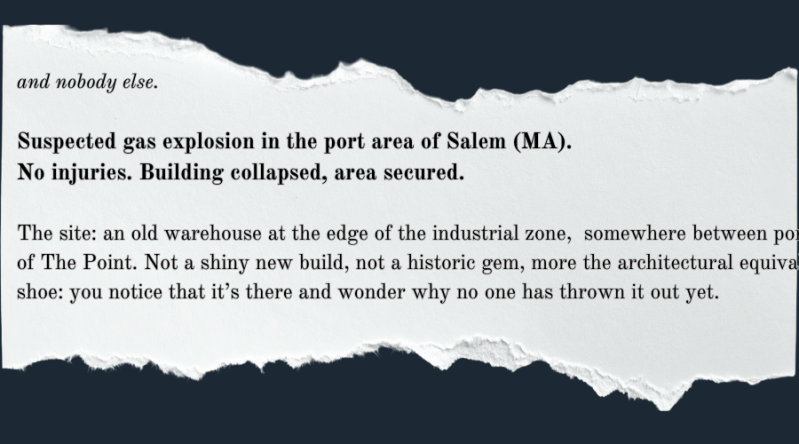
"Suspected gas explosion in the port area of Salem (MA)
No injuries. Building collapsed, area secured.
The site: an old warehouse at the edge of the industrial zone, somewhere between port noise and the back of The Point. Not a shiny new build, not a historic gem, more the architectural equivalent of a worn‑out shoe: you notice that it’s there and wonder why no one has thrown it out yet.
Perfect for simply disappearing without further ado."
Only this warehouse had decided to be more polite than necessary when disappearing.
“There’s a bang, we set off, same as always,” he told me. “To be honest I was almost disappointed – with a gas explosion you expect at least a bit of action. But all we had was a pile of rubble between completely intact buildings. Or what passes for an intact building in this area, which is usually what the building code requires, not what humans require.”
He scrolled through the photos on his work phone. Concrete, metal, the usual debris. And yet, something about it struck me as… neat.
“Look at the exterior walls of the neighboring buildings.” He showed me pictures from different angles. “There should be more. Broken glass, debris, blast marks on the houses next door. Instead it looks like the building simply decided staying up was no longer worth the effort and just… sat down.”
He didn’t use a technical term. He just said: “Accidents are messier.”
His colleagues still ticked “suspected gas explosion”. The form has a box for that, and there is no option for “polite, inward-collapsing probability” or “building tired of life”.
The fact that no one was injured could be chalked up as luck. The explosion occurred during a time slot when the hall was officially empty, no deliveries, no shift, nothing. That something like this happens when no one happens to be there – fair enough. It happens.
The fact that the warehouse folded in on itself as if someone had given it an origami diagram – not so often.
“You know what really bothered me?” he asked. “The cars.”
They were all still where they had been before the bang. No broken glass, no bent mirrors, no nicely dented hoods. The piles of rubble ended neatly before they even scratched a paint job.
“It was as if someone had drawn an invisible frame around the warehouse and told the stones: you may fall here, but not there.”
He handed me a photo in which an intact windshield has been mockingly decorated with a smiley face next to collapsed walls.
“If that was gas,” he said, “it behaved damn well.”

Normally that would have been the end of it. File the report, tick it off, move on. A city like Salem has enough real fires where people, memories and insurance premiums are at stake. One less old warehouse? Most people would have treated that as free urban renewal.
But then there was the official order for a supplementary structural and forensic investigation into the cause of the damage. In administrative language that means: somebody wanted to know in great detail why a building had collapsed in which, officially, nothing had been happening for years.
“We had no casualties, no media interest, no political stake,” he said. “The thing was an eyesore. When a box like that falls down on its own, people usually applaud. And suddenly someone wants a full‑blown expert report.” He leaned back.
“That’s when I thought: either the gas has personally offended someone very important – or something’s off.”
He was part of the team that went out again: structural engineers, forensic experts, someone from the city, someone who never gave their name and who was not mentioned in the report later.
“And then there it was,” he said. “Controlled demolition. Not suspected, not probable – confirmed. Multiple charges, placed so the thing comes straight down. No improvisation, no amateur.”
I asked him how often he’d seen something like that: a worthless building in a bad area, no casualties – and then an expensive investigation, only to end up ceremoniously establishing that somebody had gone to great lengths to remove precisely this building without hurting anyone.
He thought for a moment. “Never.”
And what happened after that finding? Nothing.
No public report, no press conference, no great outrage that someone had carried out an illegal demolition in the middle of a city. The note “controlled demolition” went into a file that quietly disappeared into storage.
“We get the summary, sign that we’ve read it, that’s it,” he said. “No request to open an investigation, no follow‑up questions, no ‘who ordered this?’. As if the answer to how something happened was more important than who did it. Or maybe as if the who had never really been in question.”
“That’s the point where you have to decide,” he said. “Either you accept that you’re supposed to not care – or you start asking stupid questions.”
He had opted for the stupid questions – and that’s how he’d ended up across from me.
He told me how, in the days after the report, he couldn’t get the site out of his head. How he’d gone back there once more in his own time, although the area should still have been cordoned off. But the tape had been removed surprisingly quickly; the rubble was freely accessible.
“I was standing there and felt as if… it’s hard to describe… as if I were pulsing,” he said. “Right in the middle of that rubble I felt more alive and focused than I had in a long time, as if retirement was still decades away – even though I know the boys are already planning the party.”
In the days that followed he started asking around. First in his own circle, then cautiously outside it. He ran into a lot of variations of “Drop it.”
“I know how this sounds. A firefighter close to retirement who clings to a closed case while real problems burn elsewhere. Believe me, I’ve told myself all of that.”
He paused for a moment. “But I’ve seen the rubble,” he added. “And I’ve read the report. At some point you either start doubting your perception – or the official story. And then there was this feeling—”
He looked at me as if he were almost embarrassed. “—this feeling at that place. That I feel so good there. Since then I’ve been going back regularly… at least whenever I’m nearby. Sometimes I get out of the car. Something about it won’t let me go.”
It sounded like exactly the kind of obsession that makes colleagues nod politely while mentally checking their calendar for the next medical exam.
Instead, I asked for the case number.
The official documentation of the collapse was thin. Incident report, short notice, a few photos, the note about the additional investigation – and then the single line: “Controlled demolition, responsible party unknown.” No hint of an open case, no responsible department, no contact for enquiries. The file stopped exactly where, in a normal story, the interesting part begins.
At city hall the answers were “It went through several departments” and “We’d have to check internally, we’ll call you back” when I asked who had ordered the investigation. The call never came.
Instead, my informant and I found out that the building hadn’t been as abandoned before the explosion as it had looked at first.
So we started asking questions together. First with the obvious people: waste management, the private security for the port area, a few residents on the border to The Point who seemed to keep close track of what happens in their backyards.
Most of them claimed not to have noticed anything. Some knew very precisely that they hadn’t seen anything. Two or three did eventually admit that they’d “seen people” from time to time. Not party crowds, no loud music. Small groups on foot, inconspicuously dressed, no clear age profile. Always the same direction, always the same corner of the site.
Sometimes they were carrying things that looked like yoga mats, or bags. Backpacks. One of them often had a metal bottle. No one got drunk. No one shouted. These were “boring people”.
I tried to track down traces online as best I could under the circumstances. Among the usual offerings – meditation evenings, singing bowls, full‑moon ceremonies in living‑room ambience – a name came up I’d never heard before: A. Ingda‑Thod.
Not a registered association, not a church, not any kind of formal organisation, just “an open circle for people who want to develop their potential”. The address of the collapsed warehouse and a contact email that bounced.
Not what I’d call a hot lead. But from that point on, the site was no longer just a ruin to me. It had been a meeting place. For people who believed they were developing their potential. Were they the target?
Did someone want to stop these people meeting there? Should the group be attacked? But if you want to take out a group, you don’t blow up their meeting place in their absence. Someone had gone to great lengths to avoid hurting anyone – end of the theory of “an attack on a dangerous group”.
A group like that can probably meet anywhere. If you want to stop them, you don’t attack the one thing they can easily replace.
We sat over our notes and kept coming back to the same point: Everything pointed to the place itself having been the target. But why? Was there any connection to this group at all?
The longer we looked at the group, the less it could be pinned down. The name of the contact person never showed up in any official registry, no association, no company, no legal imprint. I was starting to doubt it was even a real name.
My informant gradually warmed up and started talking about things he’d left out before because they felt dubious even to him.
He said that for some time now he’d been able to read licence plates clearly from a distance, as if he were zooming in on them. By now he was convinced he’d developed a special ability.
Classic placebo effect brought on by spending too much time thinking about A. Ingda‑Thod and his potential‑development circle – right? He certainly hadn’t developed superpowers from anything we were looking into. Otherwise I’d be enjoying them too, which I most definitely am not.
So what did we have?
- an empty warehouse,
- a perfectly executed demolition without casualties,
- an investigation that stopped asking questions halfway through,
- the name A. Ingda‑Thod and an esoteric group that claimed to train “potential” and had vanished into thin air,
- and a firefighter who was suddenly seeing things more sharply than before – and who himself would prefer to write it off as a placebo effect.
What was missing was what any normal story would start with: a “who”.
Who had ordered this additional investigation?
Who had been so keen to establish how the building had been demolished – and so uninterested in who was responsible?
In principle it could have been anyone with an interest in making sure nothing happened at that specific set of coordinates on the city map – which, phrased like that, sounds fairly insane, but that was exactly the line of thought.
So, one by one, purely hypothetical, with no claim to completeness:
There’s the obvious version: some security agency, official or semi‑official, that doesn’t like seeing groups meet in the shadow of a harbour to “train their potential” while staying as invisible as only “boring people” can. In that scenario, the risk factor would be the people, not the warehouse.
Then there’s the completely opposite theory: it was the group itself. People who think about potential‑development long enough until they decide that the place where they’ve been doing it carries too many traces. A kind of controlled self‑destruction of their own rehearsal room, before anyone else can find out what really happened there – or what happened to them there.
A more sober reading: follow the money. A harbour area slated for “development” doesn’t mix well with a box that attracts the wrong kind of people. An illegal demolition is cheaper than a lengthy legal process, an expert report is cheaper than a public debate, and a file that disappears into the right drawer is the cheapest option of all. In that version, A. Ingda‑Thod is just a footnote.
If you like the historical angle, you can add another layer: families, institutions, circles that put a lot of energy into making sure Salem tells a particular story about itself – and not others. The idea that people are once again meeting somewhere to work on “unusual abilities” may simply be intolerable to some. In that case you remove the place before the stories can take hold. Let these people do their witchcraft somewhere else.
And then there’s the most uncomfortable possibility: that the warehouse was never the centre of anything, just a symptom. That this is not primarily about people with yoga mats but about places where people change. In that scenario someone is interested in coordinates where “too much” is happening – and removes them. Whoever “someone” is remains in the dark. It could be an agency, a private network, a very old idea wearing ever‑changing uniforms.
If you stay on that mental chessboard long enough, you end up right back at: it could have been anyone. Maybe it was the fire department itself. Maybe it was city hall. Maybe it was a mixture of all of them, and the only one who genuinely didn’t play along was the man sitting across from me, telling me that, ever since, licence plates look sharper.
The longer we extended the list, the clearer it became that “Who is hunting whom here?” was the wrong question.
Maybe no one is hunting anyone. Maybe everyone is hunting something different:
Security people hunt risks, investors hunt returns, esoteric circles hunt enlightenment, heritage‑keepers hunt the feeling of control. And we hunt a story that lines up all these different pieces of prey in a single row.
The picture of some lone hunter somewhere in Salem who orders a warehouse blown up so that a handful of people can no longer “develop their potential” is probably too small. What remains is the odd leftover: the decision to spend that much energy on a place that, officially, wasn’t worth any.
You can get off the ride here.
You can say: this is the story of a man close to retirement who clings to a heap of rubble because the only alternative is a stack of forms. The story of a group calling itself a “potential development circle” and disappearing as quickly as such circles often do. The story of a town that slaps its own horror branding on anything that dares to deviate from the norm.
You read it and your first thought is: “Unbelievable, there has to be something to this.”
Your second: “Wait. That’s too much. That can’t all be true.”
Your third: “If it’s all nonsense – why is it documented in so much detail?”
Your fourth: “Maybe I’m just meant to be kept busy.”
Maybe this collapse really is just that: much ado about nothing.
A polite explosion in a tired building, a few over‑interpreted coincidences, a firefighter with very good eyesight and a reporter with too much time.
Maybe it is a distraction. From day‑to‑day politics, from other projects at the port, from contracts that have more to do with pipes and budget lines than with perception and potential.
And maybe it’s still more than that.
Maybe it’s one of those cases that are built so they look like an exaggeration. Where any reasonable person automatically concludes that it’s all too much, too far‑fetched, too “The Truth™”.
And somewhere underneath, a small, unruly voice asks a question you’re better off keeping to yourself:
How likely is it, really, that the place at the centre of all this has no special significance at all – of all towns, in a place like Salem, where inconspicuous locations have always had a habit of turning into remarkably persistent stories?
*Editor’s note
Our long‑standing author of the The Truth™ section, whose last piece dealt with the question of what artificial intelligence in fridges really stores, is currently unavailable to the editorial team.
We have no verified information regarding the circumstances of his disappearance.
Officially, we assume personal reasons. We do not comment on unofficial speculation.
As of this issue, Marcus Ellingford takes over responsibility for the The Truth™ section.
Ellingford has so far worked as a researcher in the background and knows the archives, sources and loose ends of the section as well as almost anyone.
The editorial team is using this change to put The Truth™ on a new stylistic footing:
fewer loose fragments, more coherent investigations that are allowed to read like stories – while keeping the same mandate:
To keep digging where official explanations stop.
For this debut the editors are deliberately giving Ellingford the cover and more space than is usual for the section.
The length of the article is not a mistake, but part of the decision to tell The Truth™ differently – with the same assignment.
Kommentar hinzufügen
Kommentare